Showing posts with label president bush. Show all posts
Showing posts with label president bush. Show all posts
Wednesday, March 3, 2010
Karl Rove's Memoir: Apparently, A Work of Fiction
The Associated Press reports that in his new memoir, Karl Rove continues to use the September 11 attacks to justify the invasion of Iraq. He also blames himself for failing to convince the public that President Bush did not start the war under false pretenses once the hunt for weapons of mass destruction came up dry. Rove insists however, that Bush did not knowingly mislead the public. Rove also praises Bush's handling of Hurricane Katrina and claims that local officials are the ones responsible for the terrible response. Rove's memoir should make a splash on the Best-Selling Fiction list.

Wednesday, September 9, 2009
The Bloggacuda Returns: Sarah Palin and the Problem With "Common Sense"
The Bloggacuda is back with a new (ghostwritten?) op-ed in the Wall Street Journal that laments the prospect of healthcare reform proposed by "the Democrats." Palin's "new" essay offers more distortions and more hypocrisy.
Palin and the Problem of "Common Sense"
Palin describes the Democrats' proposals as resting on the notion that "increased government involvement" can fix the healthcare system. She then contests this view, arguing that:
Palin Seemingly Unaware of Insurance Company Bureaucrats
Palin also cannot resist mentioning her infamous death panel distortion, proudly stating that the argument resonated with many Americans. True -- but many of the same people fell for the bogus claim that Saddam Hussein had weapons of mass destruction. That lie cost thousands of lives and hundreds of billions of dollars.
Palin argues that Obama wants to create a nongovernmental bureaucracy to make decisions regarding life and death Medicare treatments. Apparently, the Bloggacuda lives in a parallel universe where insurance company bureaucrats do not already determine the treatments that companies will cover for plan participants. Instead, in Palin's world, doctors and patients make these decisions exclusively. Insurance companies simply pay the bill.
Palin's argument rests on a stunningly inaccurate understanding of the nation's healthcare system. Private bureaucrats already determine what treatments to cover, and doctors who desire reimbursement (i.e., all doctors) comply with those guidelines.
Also, Palin seems to criticize the nongovernmental nature of a proposed Medicare advisory panel, but this objection conflicts with her "more government is bad" narrative. In any event, the advisory group would only "advise" the federal government; any actual changes in Medicare coverage would require the approval of Congress.
Palin Blames Democrats for Expensive Policies That Bush Created
Palin also accuses Democrats of creating the very "waste and inefficiency" and "unwarranted subsidies" that Obama has pledged to cut from Medicare. Palin's argument, however, proves that the "common sense" crowd does not read.
When Obama proposed cutting wasteful subsidies to Medicare providers, he was referring to President Bush's implementation of the privately administered Medicare Advantage program, which costs 13% more than the traditional governmental plan. A Republican -- not a Democrat -- introduced the Medicare subsidies that Obama has promised to cut.
Here's an even more stunning fact: Senator John McCain -- the leader of the McCain/Palin ticket -- also proposed reversing Bush and cutting these subsidies in order to reign in the expense of the program. During the presidential campaign, this proposal had wide bipartisan support. Palin's flawed analysis suggests that she did not pay attention to or did not understand the very issues she faced as a candidate for Vice President.
Palin's Shameful Cherry-Picking of Congressional Budget Office Reports
Palin continues to engage in blatant cherry-picking of data to support her claims. She cites a CBO study that shows the House proposal would add over $200 billion to the deficit over 10 years (but it would also insure 47 million more people). But as the Liberal Values Blog thoroughly details, Palin ignores a CBO study which concludes that tort reform -- something she has embraced as an essential component of healthcare reform -- will not reduce medical costs.
Palin's Contradictory Embrace of "Big Guv'ment"
Finally, while Palin's op-ed decries "big guv'ment," the Bloggacuda wants to expand the reach of the national government. Palin advocates tort reform, which, as I have previously argued, would add a new layer of federal control over the judicial systems in 50 states, constrain jury decisions, and limit the ability of private litigants to seek justice as they deem appropriate.
Palin also favors "giving all individuals the same tax benefits received by those who get coverage through their employers," but the favorable treatment of employer health plans already represents the largest tax expenditure. Palin's proposal would cause an even greater revenue loss and increase the deficit.
Palin also supports replacing Medicare with vouchers, a plan proposed by the conservative Cato Institute. Without the government or other centralized entity to negotiate cheaper costs, the price of health insurance for seniors would likely soar, causing them to exert their political power and demand annual voucher increases. The spending implications are tremendous. On the other hand, a refusal to support higher vouchers would sound a lot like the "rationing" of care, disguised as individual decisionmaking.
Palin's op-ed offers a more thoughtful approach than her previous commentary, but it does not provide any viable solutions to the problems that plague the nation's medical services markets.
Palin and the Problem of "Common Sense"
Palin describes the Democrats' proposals as resting on the notion that "increased government involvement" can fix the healthcare system. She then contests this view, arguing that:
Common sense tells us that the government's attempts to solve large problems more often create new ones. Common sense also tells us that a top-down, one-size-fits-all plan will not improve the workings of a nationwide health-care system that accounts for one-sixth of our economy. And common sense tells us to be skeptical when President Obama promises that the Democrats' proposals "will provide more stability and security to every American."Adolph Reed, a Professor of Political Science at the University of Pennsylvania, once said during a lecture that "the problem with common sense is that people use it as an excuse not to read." Apparently, Palin falls into this category. If Palin had actually read the various proposals, she would not have seen a "one-size-fits-all plan." But Palin and other conservatives have consistently resorted to deception when discussing Democrat-sponsored proposals for healthcare reform.
Palin Seemingly Unaware of Insurance Company Bureaucrats
Palin also cannot resist mentioning her infamous death panel distortion, proudly stating that the argument resonated with many Americans. True -- but many of the same people fell for the bogus claim that Saddam Hussein had weapons of mass destruction. That lie cost thousands of lives and hundreds of billions of dollars.
Palin argues that Obama wants to create a nongovernmental bureaucracy to make decisions regarding life and death Medicare treatments. Apparently, the Bloggacuda lives in a parallel universe where insurance company bureaucrats do not already determine the treatments that companies will cover for plan participants. Instead, in Palin's world, doctors and patients make these decisions exclusively. Insurance companies simply pay the bill.
Palin's argument rests on a stunningly inaccurate understanding of the nation's healthcare system. Private bureaucrats already determine what treatments to cover, and doctors who desire reimbursement (i.e., all doctors) comply with those guidelines.
Also, Palin seems to criticize the nongovernmental nature of a proposed Medicare advisory panel, but this objection conflicts with her "more government is bad" narrative. In any event, the advisory group would only "advise" the federal government; any actual changes in Medicare coverage would require the approval of Congress.
Palin Blames Democrats for Expensive Policies That Bush Created
Palin also accuses Democrats of creating the very "waste and inefficiency" and "unwarranted subsidies" that Obama has pledged to cut from Medicare. Palin's argument, however, proves that the "common sense" crowd does not read.
When Obama proposed cutting wasteful subsidies to Medicare providers, he was referring to President Bush's implementation of the privately administered Medicare Advantage program, which costs 13% more than the traditional governmental plan. A Republican -- not a Democrat -- introduced the Medicare subsidies that Obama has promised to cut.
Here's an even more stunning fact: Senator John McCain -- the leader of the McCain/Palin ticket -- also proposed reversing Bush and cutting these subsidies in order to reign in the expense of the program. During the presidential campaign, this proposal had wide bipartisan support. Palin's flawed analysis suggests that she did not pay attention to or did not understand the very issues she faced as a candidate for Vice President.
Palin's Shameful Cherry-Picking of Congressional Budget Office Reports
Palin continues to engage in blatant cherry-picking of data to support her claims. She cites a CBO study that shows the House proposal would add over $200 billion to the deficit over 10 years (but it would also insure 47 million more people). But as the Liberal Values Blog thoroughly details, Palin ignores a CBO study which concludes that tort reform -- something she has embraced as an essential component of healthcare reform -- will not reduce medical costs.
Palin's Contradictory Embrace of "Big Guv'ment"
Finally, while Palin's op-ed decries "big guv'ment," the Bloggacuda wants to expand the reach of the national government. Palin advocates tort reform, which, as I have previously argued, would add a new layer of federal control over the judicial systems in 50 states, constrain jury decisions, and limit the ability of private litigants to seek justice as they deem appropriate.
Palin also favors "giving all individuals the same tax benefits received by those who get coverage through their employers," but the favorable treatment of employer health plans already represents the largest tax expenditure. Palin's proposal would cause an even greater revenue loss and increase the deficit.
Palin also supports replacing Medicare with vouchers, a plan proposed by the conservative Cato Institute. Without the government or other centralized entity to negotiate cheaper costs, the price of health insurance for seniors would likely soar, causing them to exert their political power and demand annual voucher increases. The spending implications are tremendous. On the other hand, a refusal to support higher vouchers would sound a lot like the "rationing" of care, disguised as individual decisionmaking.
Palin's op-ed offers a more thoughtful approach than her previous commentary, but it does not provide any viable solutions to the problems that plague the nation's medical services markets.
Tuesday, September 8, 2009
Vast Rightwing Conspiracy Theorists
Vast rightwing conspiracy theorists have taken over political discourse, and the results are absolutely disturbing. Rather than focusing on substantive matters, policymakers and analysts have expended precious time debunking the latest round of projectile vomiting over some imagined attempt by Obama/Pelosi/Democrats/Liberals/Communists/Socialists/Nazis to end life as "we" know it.
During the earliest part of Obama's presidency, Republicans lacked a coherent voice. They have found this voice, however, by organizing around rightwing conspiracy theories. Consequently, they have created some unity and garnered attention from the public. But they have accomplished these goals by embracing some of the most outlandish and deceitful "theories."
Here are just a few shameful items promoted by vast rightwing conspiracy theorists.
1. Obama is not a "natural-born citizen." The "birthers" are the only group of conspiracy theorists who can compete with the "truthers" (Bush knew about 9/11 before it occurred) in terms of utter creepiness. The birthers inexplicably and stubbornly believe that Obama is not a natural born citizen of the United States and that he does not meet the constitutional requirements for President of the United States.
The birthers' belief is immune to facts but highly accommodating of blatant lies and inaccuracies. For example, birthers recently experienced a collective orgasm after they received "smoking-gun evidence" that Obama was born in Kenya -- rather than the United States. There was a terrible problem with the evidence, however: It was a web-doctored Australian birth certificate created and sent to birthers by a conniving liberal blogger. Despite numerous letdowns and no proof, the birthers continue to spread their conspiracy theory and to search for new believers. They have also managed to garner support and sympathy from Republican politicians.
2. Obama = Socialist. During the presidential campaign, the McCain team floated the notion that Obama is a socialist. Rightwingers jumped on board, perhaps because nothing else was helping to improve McCain's campaign numbers. Since the election, this conspiracy theory has reemerged with great force.
Unfortunately, the socialism conspiracy theorists are just as bankrupt as the birthers. First, the group fails to offer a coherent definition of socialism. As with many economic theories, including capitalism, socialists embrace varying policy positions. Typically, however, socialism involves the advocacy of government and worker ownership of the means of production and centralized planning of output. Rather than proving that Obama is a socialist, current White House policies place Obama strongly within the capitalism camp.
Karl Marx would probably roll his eyes in his grave if he knew that socialism involved dumping a trillion dollars into the United States banking system in order to save global capitalism. In addition, if the banking or automobile bailout makes Obama a socialist, then Bush is a socialist as well because he proposed and lobbied for the passage of TARP and interpreted it as covering auto manufacturers.
Furthermore, if the creation of a public health plan to cover a specific slice of the population that lacks insurance qualifies Obama as a socialist, then he is simply carrying out the socialist policies of his predecessors. Medicare, Medicaid, the Veterans Administration and SCHIP are all public health plans for specific slices of the population. Moreover, because states co-administer Medicare, Medicaid, and SCHIP, then all 50 states are socialist economies as well. Also, because the GOP has been promising seniors that it will protect Medicare and the VA, then the GOP apparently supports socialism as well.
3. Death Panels. This idea has received a lot of respect from conservatives. The Bloggacuda Sarah Palin initiated this troubling discourse by attacking a provision in the House legislation that authorizes governmental reimbursement of end of life counseling for certain classes of people who hold public-sponsored health plans. The provision, however, only authorizes coverage; it does not mandate the counseling.
Medical groups -- including the American Medical Association -- endorse this type of counseling. Medical providers actually lobbied for the provision. Equating "coverage" of counseling with "mandatory" counseling is irrational and deceptive. Insurance policies list coverage of many procedures. Applying the logic of the death panel theorists, an insurance policy that covered abortion services would actually mandate abortion. But if the same policy covered childbirth services too, it would mandate childbirth and abortion for the same pregnancy! Perverse logic inevitably leads to perverse outcomes.
4. Government Is Taking Over Medicare. Conservatives have exploited Obama's proposed cuts in Medicare costs to scare some seniors into believing that the Democrats want to cut Medicare itself. This argument often gets collapsed into a general assertion that Obama wants to take over Medicare and make decisions on behalf of doctors and patients.
Ironically, this is one conspiracy theory that has some truth to it. The government does have its hands on Medicare. But there is a good explanation: Medicare is a government-run health plan! Despite spewing against the perils of "socialized medicine," Republicans have tried to portray themselves as the guardians of Medicare beneficiaries. These individuals, however, are covered by a public health plan -- which Republicans describe as socialism.
The Medicare conspiracy theories have led to some perverse results. For example, some angry conservative seniors have criticized "public plans," while benefiting from Medicare (the nation's largest public plan). Recently, a senior was violently injured (finger bitten off) while protesting healthcare reform. Although conservatives promoted the story as an example of the evils of socialized medicine/Obamacare, the injured man went to a hospital and received treatment. Ironically, the injured man was insured by Medicare, even though he came out to protest the creation of a public plan.
Furthermore, a recent poll shows that 62% of Republicans believe that the government should "stay out of Medicare," which is factually impossible. Facts and logic, however, are irrelevant to vast rightwing conspiracy theorists. To be fair, however, nutty leftwing conspiracy theorists do not prioritize facts either.
Final Take
This blog used to publish far more essays defending Republicans and criticizing liberals. But now that the Republicans have decided to embrace the partially successful -- yet intellectually bankrupt -- strategy of promoting rightwing conspiracy theories, I have had very little to offer in defense of Republicans. I suspect that if the public continues to shine light on these conspiracy theories and the media decides to tackle matters other than political strife, then the strategy will backfire. So long as these deceitful and factless theories define contemporary conservative discourse, serious analysts will not take conservatives seriously.
During the earliest part of Obama's presidency, Republicans lacked a coherent voice. They have found this voice, however, by organizing around rightwing conspiracy theories. Consequently, they have created some unity and garnered attention from the public. But they have accomplished these goals by embracing some of the most outlandish and deceitful "theories."
Here are just a few shameful items promoted by vast rightwing conspiracy theorists.
1. Obama is not a "natural-born citizen." The "birthers" are the only group of conspiracy theorists who can compete with the "truthers" (Bush knew about 9/11 before it occurred) in terms of utter creepiness. The birthers inexplicably and stubbornly believe that Obama is not a natural born citizen of the United States and that he does not meet the constitutional requirements for President of the United States.
The birthers' belief is immune to facts but highly accommodating of blatant lies and inaccuracies. For example, birthers recently experienced a collective orgasm after they received "smoking-gun evidence" that Obama was born in Kenya -- rather than the United States. There was a terrible problem with the evidence, however: It was a web-doctored Australian birth certificate created and sent to birthers by a conniving liberal blogger. Despite numerous letdowns and no proof, the birthers continue to spread their conspiracy theory and to search for new believers. They have also managed to garner support and sympathy from Republican politicians.
2. Obama = Socialist. During the presidential campaign, the McCain team floated the notion that Obama is a socialist. Rightwingers jumped on board, perhaps because nothing else was helping to improve McCain's campaign numbers. Since the election, this conspiracy theory has reemerged with great force.
Unfortunately, the socialism conspiracy theorists are just as bankrupt as the birthers. First, the group fails to offer a coherent definition of socialism. As with many economic theories, including capitalism, socialists embrace varying policy positions. Typically, however, socialism involves the advocacy of government and worker ownership of the means of production and centralized planning of output. Rather than proving that Obama is a socialist, current White House policies place Obama strongly within the capitalism camp.
Karl Marx would probably roll his eyes in his grave if he knew that socialism involved dumping a trillion dollars into the United States banking system in order to save global capitalism. In addition, if the banking or automobile bailout makes Obama a socialist, then Bush is a socialist as well because he proposed and lobbied for the passage of TARP and interpreted it as covering auto manufacturers.
Furthermore, if the creation of a public health plan to cover a specific slice of the population that lacks insurance qualifies Obama as a socialist, then he is simply carrying out the socialist policies of his predecessors. Medicare, Medicaid, the Veterans Administration and SCHIP are all public health plans for specific slices of the population. Moreover, because states co-administer Medicare, Medicaid, and SCHIP, then all 50 states are socialist economies as well. Also, because the GOP has been promising seniors that it will protect Medicare and the VA, then the GOP apparently supports socialism as well.
3. Death Panels. This idea has received a lot of respect from conservatives. The Bloggacuda Sarah Palin initiated this troubling discourse by attacking a provision in the House legislation that authorizes governmental reimbursement of end of life counseling for certain classes of people who hold public-sponsored health plans. The provision, however, only authorizes coverage; it does not mandate the counseling.
Medical groups -- including the American Medical Association -- endorse this type of counseling. Medical providers actually lobbied for the provision. Equating "coverage" of counseling with "mandatory" counseling is irrational and deceptive. Insurance policies list coverage of many procedures. Applying the logic of the death panel theorists, an insurance policy that covered abortion services would actually mandate abortion. But if the same policy covered childbirth services too, it would mandate childbirth and abortion for the same pregnancy! Perverse logic inevitably leads to perverse outcomes.
4. Government Is Taking Over Medicare. Conservatives have exploited Obama's proposed cuts in Medicare costs to scare some seniors into believing that the Democrats want to cut Medicare itself. This argument often gets collapsed into a general assertion that Obama wants to take over Medicare and make decisions on behalf of doctors and patients.
Ironically, this is one conspiracy theory that has some truth to it. The government does have its hands on Medicare. But there is a good explanation: Medicare is a government-run health plan! Despite spewing against the perils of "socialized medicine," Republicans have tried to portray themselves as the guardians of Medicare beneficiaries. These individuals, however, are covered by a public health plan -- which Republicans describe as socialism.
The Medicare conspiracy theories have led to some perverse results. For example, some angry conservative seniors have criticized "public plans," while benefiting from Medicare (the nation's largest public plan). Recently, a senior was violently injured (finger bitten off) while protesting healthcare reform. Although conservatives promoted the story as an example of the evils of socialized medicine/Obamacare, the injured man went to a hospital and received treatment. Ironically, the injured man was insured by Medicare, even though he came out to protest the creation of a public plan.
Furthermore, a recent poll shows that 62% of Republicans believe that the government should "stay out of Medicare," which is factually impossible. Facts and logic, however, are irrelevant to vast rightwing conspiracy theorists. To be fair, however, nutty leftwing conspiracy theorists do not prioritize facts either.
Final Take
This blog used to publish far more essays defending Republicans and criticizing liberals. But now that the Republicans have decided to embrace the partially successful -- yet intellectually bankrupt -- strategy of promoting rightwing conspiracy theories, I have had very little to offer in defense of Republicans. I suspect that if the public continues to shine light on these conspiracy theories and the media decides to tackle matters other than political strife, then the strategy will backfire. So long as these deceitful and factless theories define contemporary conservative discourse, serious analysts will not take conservatives seriously.
Saturday, September 5, 2009
Jesus Would Want You to "Heal the Sick"
I am amazed that many conservative Christians are treating healthcare reform as an unpardonable sin, but many of them were cheerleaders for President Bush who invaded two countries and killed thousands of people unnecessarily.
A popular argument against healthcare reform -- especially the inclusion of a public plan option -- cites the expense of insuring all Americans and the potential impact on the deficit. I agree that budgetary impact is an important concern (of any policy). I am doubtful that the government can provide sufficient "seed money" for the public plan without a tax increase or relaxation of the favorable tax treatment given to employer-sponsored health plans.
Some economists argue that the government can get enough revenue by taxing only the highest income earners (e.g., people making over $250,000). But even this goal should receive enlightened debate.
Bush Broke the Bank to Reward the Wealthy and to Kill Thousands Unnecessarily
President Bush slashed taxes for the wealthiest Americans and provided a modest middle-class tax cut as well. He also went on a spending frenzy, particularly by launching two wars. Although a majority of Americans initially supported both wars, they now tend to view both as unfortunate mistakes. Saddam Hussein did not have WMDs, and terrorism will not end even if the United States captures Osama bin Laden.
Most economists accurately forecast the impact of Bush's tax cuts and wars on the deficit. Bush turned a record surplus into a record deficit by cutting taxes and boosting spending. Yet, most conservatives championed him as "their candidate." Although many diehard and consistent fiscal conservatives complained about Bush's spending, in general neither fiscal nor social conservatives offered strident criticism of Bush's fiscal practices, as they are now doing with Obama. The Tea Parties, townhall brawls, and other protests could have come a lot earlier.
Healing the Sick: A Better Justification for Deficits
Although the views of Jesus (or any other religious figure) should not dictate social policy, discussing healthcare reform in religious terms reveals some interesting contradictions between the purported faith of many social conservatives (Christianity) and their political position regarding healthcare. I strongly believe that Jesus would have passionately rebuked the use of deficit spending to fatten the pockets of the wealthy and to kill thousands of men and women unnecessarily. I also believe that Jesus would approve of deficit spending for the purpose of healing the sick.
I grew up in a conservative Christian home, and I am well versed in "the scriptures" (I love shocking liberal and conservative readers). And while I have moved beyond my childhood in many ways, I have excellent recall.
I do not remember Jesus ever endorsing the unnecessary killing of thousands. On the other hand, he seemed absolutely obsessed with healing the sick, regardless of citizenship or ability to pay. He was also a huge fan of "end-of-life" counseling, and he constantly instructed people to be prepared for death or his return (in the "twinkling of an eye"). I guess he was a death panelist too.
So to conservative Christians who believe healthcare reform is the work of the devil but who voted for Bush in 2004 (after his wars and killing had begun), do you think Jesus would feel the same way? What part of the Bible demonstrates this?
A popular argument against healthcare reform -- especially the inclusion of a public plan option -- cites the expense of insuring all Americans and the potential impact on the deficit. I agree that budgetary impact is an important concern (of any policy). I am doubtful that the government can provide sufficient "seed money" for the public plan without a tax increase or relaxation of the favorable tax treatment given to employer-sponsored health plans.
Some economists argue that the government can get enough revenue by taxing only the highest income earners (e.g., people making over $250,000). But even this goal should receive enlightened debate.
Bush Broke the Bank to Reward the Wealthy and to Kill Thousands Unnecessarily
President Bush slashed taxes for the wealthiest Americans and provided a modest middle-class tax cut as well. He also went on a spending frenzy, particularly by launching two wars. Although a majority of Americans initially supported both wars, they now tend to view both as unfortunate mistakes. Saddam Hussein did not have WMDs, and terrorism will not end even if the United States captures Osama bin Laden.
Most economists accurately forecast the impact of Bush's tax cuts and wars on the deficit. Bush turned a record surplus into a record deficit by cutting taxes and boosting spending. Yet, most conservatives championed him as "their candidate." Although many diehard and consistent fiscal conservatives complained about Bush's spending, in general neither fiscal nor social conservatives offered strident criticism of Bush's fiscal practices, as they are now doing with Obama. The Tea Parties, townhall brawls, and other protests could have come a lot earlier.
Healing the Sick: A Better Justification for Deficits
Although the views of Jesus (or any other religious figure) should not dictate social policy, discussing healthcare reform in religious terms reveals some interesting contradictions between the purported faith of many social conservatives (Christianity) and their political position regarding healthcare. I strongly believe that Jesus would have passionately rebuked the use of deficit spending to fatten the pockets of the wealthy and to kill thousands of men and women unnecessarily. I also believe that Jesus would approve of deficit spending for the purpose of healing the sick.
I grew up in a conservative Christian home, and I am well versed in "the scriptures" (I love shocking liberal and conservative readers). And while I have moved beyond my childhood in many ways, I have excellent recall.
I do not remember Jesus ever endorsing the unnecessary killing of thousands. On the other hand, he seemed absolutely obsessed with healing the sick, regardless of citizenship or ability to pay. He was also a huge fan of "end-of-life" counseling, and he constantly instructed people to be prepared for death or his return (in the "twinkling of an eye"). I guess he was a death panelist too.
So to conservative Christians who believe healthcare reform is the work of the devil but who voted for Bush in 2004 (after his wars and killing had begun), do you think Jesus would feel the same way? What part of the Bible demonstrates this?
Sunday, August 30, 2009
Selective Outrage: Conservatives Invoked Reagan's Death to Promote Liberal Stem Cell Policies
Some conservatives are experiencing a meltdown because people close to Ted Kennedy have used the occasion of his death to promote one of his greatest passions -- universal healthcare. But many of the supposedly outraged conservatives have hypocritically invoked Kennedy's illness and death in order to argue against the very reforms that Kennedy favored during his life.
Conservatives' Selective Outrage Over Death and Politics
Conservatives are exhibiting "selective outrage" over the appropriateness of mixing death and politics. In 2004, the year that Ronald Reagan died from Alzheimer's disease, former First Lady Nancy Reagan, other members of the Reagan family, and many members of Congress -- including conservatives -- used his illness and subsequent death to encourage President Bush to adopt more liberal policies related to the use of stem cells. Some researchers believe that stem cell research could be useful in the search for a cure for Alzheimer's disease.
Nancy Reagan
Former President Reagan died on June 5, 2004. During the month prior to her husband's death, Nancy Reagan sensed that the end was near. So, she made a public plea for President Bush to loosen restrictions on the use of stem cells. The former First Lady said that:
After Reagan died, 58 Senators, including 14 Republicans, sent Bush a letter urging him to ease restrictions on stem cell research. During a June 13 interview with the Times (UK), conservative Orrin Hatch, who signed the letter, specifically invoked Reagan's death in order to promote stem cell research:
The same article quotes conservative Senator Trent Lott, who makes a similar appeal to Reagan's death. Lott said that:
Senator Arlen Specter (who at the time was a Republican) happily stated that Nancy Reagan would have a "profound effect" on the issue. Specter also signed the letter to President Bush.
What Is Wrong With Doing What Kennedy Wanted?
I only found one article (published on June 17, 2004 in the Chicago Sun-Times) that makes any substantial criticism of the political use of Reagan's death. This article, written by conservative commentator Robert Novak, criticizes Democrats for embracing Reagan for political gain. Novak, however, does not criticize conservatives who did the same thing.
Novak was trying to portray Democrats as hypocrites for embracing Reagan in death, but not in life. But if this is an accurate criticism, conservatives today should not express outrage towards Democrats who are using the moment of Kennedy's passing to bring attention to healthcare reform. Instead, they should attack conservatives who have cited to Kennedy's illness and death in order to distort the content of pending healthcare reform proposals and to undermine a central goal of Kennedy's political advocacy.
Shortly before his death, Kennedy wrote a letter to Duval Patrick, the governor of Massachusetts, urging him to appoint an interim Senator until the state could hold a special election to choose a replacement. Kennedy's aides said that he was concerned that Democrats would lack an important vote on healthcare reform unless his replacement was seated. In other words, during his last days, Kennedy himself encouraged his supporters to take the necessary steps to complete his unfinished business.
Democrats who remember Kennedy by advocating healthcare reform are simply implementing the Senator's last wishes. Republicans, however, are feigning outrage in order to defeat Kennedy's work on healthcare reform. I think it is abundantly clear which side is behaving inappropriately.
PS: Kennedy's supporters actually know that he shared their political goals. It is not clear -- but probably doubtful -- that Reagan would have supported very liberal stem cell policies.
Conservatives' Selective Outrage Over Death and Politics
Conservatives are exhibiting "selective outrage" over the appropriateness of mixing death and politics. In 2004, the year that Ronald Reagan died from Alzheimer's disease, former First Lady Nancy Reagan, other members of the Reagan family, and many members of Congress -- including conservatives -- used his illness and subsequent death to encourage President Bush to adopt more liberal policies related to the use of stem cells. Some researchers believe that stem cell research could be useful in the search for a cure for Alzheimer's disease.
Nancy Reagan
Former President Reagan died on June 5, 2004. During the month prior to her husband's death, Nancy Reagan sensed that the end was near. So, she made a public plea for President Bush to loosen restrictions on the use of stem cells. The former First Lady said that:
Ronnie's long journey has finally taken him to a distant place where I can no longer reach him. . . .Because of this, I'm determined to do whatever I can to save other families from this pain. I just don't see how we can turn our backs on this.Orrin Hatch
After Reagan died, 58 Senators, including 14 Republicans, sent Bush a letter urging him to ease restrictions on stem cell research. During a June 13 interview with the Times (UK), conservative Orrin Hatch, who signed the letter, specifically invoked Reagan's death in order to promote stem cell research:
Perhaps one of the smaller blessings of Ron's passing will be a greater opportunity for Nancy to work on this issue. If someone like Nancy Reagan cannot change the president's mind, I don't think anybody can.Trent Lott
The same article quotes conservative Senator Trent Lott, who makes a similar appeal to Reagan's death. Lott said that:
I hope that affection for the Reagans and just plain human sympathy for the terrible ordeal that afflicted them both over the past 10 years will prompt some second thoughts in the administration. . . .I suspect there are many in the White House who hope that it just goes away. But I don’t think Nancy gives up anything that is close to her heart that easily.Arlen Specter
Senator Arlen Specter (who at the time was a Republican) happily stated that Nancy Reagan would have a "profound effect" on the issue. Specter also signed the letter to President Bush.
What Is Wrong With Doing What Kennedy Wanted?
I only found one article (published on June 17, 2004 in the Chicago Sun-Times) that makes any substantial criticism of the political use of Reagan's death. This article, written by conservative commentator Robert Novak, criticizes Democrats for embracing Reagan for political gain. Novak, however, does not criticize conservatives who did the same thing.
Novak was trying to portray Democrats as hypocrites for embracing Reagan in death, but not in life. But if this is an accurate criticism, conservatives today should not express outrage towards Democrats who are using the moment of Kennedy's passing to bring attention to healthcare reform. Instead, they should attack conservatives who have cited to Kennedy's illness and death in order to distort the content of pending healthcare reform proposals and to undermine a central goal of Kennedy's political advocacy.
Shortly before his death, Kennedy wrote a letter to Duval Patrick, the governor of Massachusetts, urging him to appoint an interim Senator until the state could hold a special election to choose a replacement. Kennedy's aides said that he was concerned that Democrats would lack an important vote on healthcare reform unless his replacement was seated. In other words, during his last days, Kennedy himself encouraged his supporters to take the necessary steps to complete his unfinished business.
Democrats who remember Kennedy by advocating healthcare reform are simply implementing the Senator's last wishes. Republicans, however, are feigning outrage in order to defeat Kennedy's work on healthcare reform. I think it is abundantly clear which side is behaving inappropriately.
PS: Kennedy's supporters actually know that he shared their political goals. It is not clear -- but probably doubtful -- that Reagan would have supported very liberal stem cell policies.
Thursday, June 18, 2009
IMPORTANT NEWS ALERT: Former President George W. Bush Apparently Suffering from Acute Amnesia
An article in today's Washington Times indicates that former President George W. Bush is suffering from acute amnesia. The article covers a speech Bush delivered in Erie, Pennsylvania. After the speech, Bush answered questions from the audience.
The article reports that Bush, adhering to protocol that governs former presidents, declined to criticize President Obama directly. Bush's defense of many of his policies, however, implicitly criticize Obama (or at least validate many conservative critiques of Obama).
A closer reading of Bush's comments reveals that he is apparently suffering from acute amnesia. Bush, for example, stated that:
Furthermore, even after many Republicans criticized the idea of providing federal financial assistance to the automobile industry, President Bush (not Obama) proposed using TARP funds to bail out Detroit. TARP for banks and car companies began during the Bush administration, not with Obama.
To his credit, Bush resisted the opportunity to criticize Obama for closing the Guantanamo Bay detention center. Prior to leaving office, Bush said that he wanted to close the facility as well.
Nevertheless, Bush's comment on the danger of terrorists leaves the impression that he suffers from amnesia. For example, Bush stated:
Furthermore, Bush seems unable to recall that President Obama apparently agrees with his comments about the dangers of Guantanamo Bay detainees. Obama, like Bush, has decided to use military tribunals, in addition to civilian courts, to prosecute suspected terrorists. Obama has also stated that the government will use the controversial practice of "preventive detention" for "dangerous" individuals who do not face prosecution in either civilian or military courts. The Washington Times article does not mention whether Bush acknowledged the overlap between his policies and Obama's policies related to terrorism, nor does it report the contradictions between Bush's words and his policies.
Finally, Bush seems unable to comprehend current proposals for health care reform. For example, he said that:
The article reports that Bush, adhering to protocol that governs former presidents, declined to criticize President Obama directly. Bush's defense of many of his policies, however, implicitly criticize Obama (or at least validate many conservative critiques of Obama).
A closer reading of Bush's comments reveals that he is apparently suffering from acute amnesia. Bush, for example, stated that:
I know it's going to be the private sector that leads this country out of the current economic times we're in. . . . You can spend your money better than the government can spend your money.This simple truism, however, hides some important issues, like the fact that Bush -- not Obama -- proposed TARP (or the "bailout") and signed it into law. Bush and Treasury Secretary Paulson advocated the passage of TARP on the grounds that pumping nearly $1 trillion of "our money" into the private sector would help end the financial crisis.
Furthermore, even after many Republicans criticized the idea of providing federal financial assistance to the automobile industry, President Bush (not Obama) proposed using TARP funds to bail out Detroit. TARP for banks and car companies began during the Bush administration, not with Obama.
To his credit, Bush resisted the opportunity to criticize Obama for closing the Guantanamo Bay detention center. Prior to leaving office, Bush said that he wanted to close the facility as well.
Nevertheless, Bush's comment on the danger of terrorists leaves the impression that he suffers from amnesia. For example, Bush stated:
[T]here are people at Gitmo that will kill American people at a drop of a hat and I don't believe that -- persuasion isn't going to work. Therapy isn't going to cause terrorists to change their mind. . . .Although Bush mocked the idea of using therapy to reform terrorists, he sent many Saudi detainees from Guantanamo Bay to Saudi Arabia in order to participate in the "Prince Mohammed bin Nayef Centre for Care and Counseling" program, which uses a 12-step program, combined with therapy, to rehabilitate terrorists. The program enjoys mixed reviews, and some of the detainees Bush referred to the program have resumed their participation in Al Qaeda.
Furthermore, Bush seems unable to recall that President Obama apparently agrees with his comments about the dangers of Guantanamo Bay detainees. Obama, like Bush, has decided to use military tribunals, in addition to civilian courts, to prosecute suspected terrorists. Obama has also stated that the government will use the controversial practice of "preventive detention" for "dangerous" individuals who do not face prosecution in either civilian or military courts. The Washington Times article does not mention whether Bush acknowledged the overlap between his policies and Obama's policies related to terrorism, nor does it report the contradictions between Bush's words and his policies.
Finally, Bush seems unable to comprehend current proposals for health care reform. For example, he said that:
There are a lot of ways to remedy the situation without nationalizing health care. . . .I worry about encouraging the government to replace the private sector when it comes to providing insurance for health care.Of course, President Obama has not proposed "nationalizing health care." Instead, at most, he supports a public plan option that will serve alongside private insurance. If this represents "nationalized" health care, then the country already has a nationalized system, because the federal government and the fifty states already serve as public payers of health care, under Medicare, Medicaid, the VHA, SCHIP, and various other programs. Although conservatives argue that an additional public plan option would cause the collapse of private insurance, this point is debatable, and it certainly is not a specific piece of Obama's proposals.
Saturday, May 9, 2009
They're Baaack. . . .
Recently, the New York Times reported that the Obama administration would likely bring back the controversial military commissions in order to prosecute terrorism suspects. During the Bush administration, the commissions generated a lot heat among civil libertarians in the United States and abroad.
As a Senator, Obama voted against the Military Commissions Act of 2006, and he successfully campaigned on the promise that he would would restore the image of the United States in the international community. Many liberals view the Bush administration's denial of basic civil rights as one of the greatest blemishes on the image of the United States.
During his campaign, President Obama criticized the use of military commissions, rather than federal courts, to prosecute terrorism suspects. When he first took office, President Obama issued a series of executive orders, including one that imposed a 120-day stay on all proceedings in military tribunals while a task force studied and developed alternatives to the existing process.
Today, additional news sources confirm that the Obama administration will "stay the course" and utilize military tribunals, rather than federal courts, to prosecute accused terrorists. According to the Washington Post the government will reform the rules of the military commissions in order to provide greater procedural rights to defendants:
Closing Statement
In a prior blog post on this subject, I summarized the policies that Obama has pursued, but which liberals passionately criticized during the Bush administration. I have reprinted that list below, with an obvious modification.
The Obama administration has embraced many of the same positions that liberals and Obama himself criticized during the Bush administration. For example:
* Obama and members of his administration have embraced the use of rendition. Many of Obama's most ardent defenders blasted progressives who criticized Obama on rendition as jumping the gun. Today, their arguments look even more problematic than in the past.
* Obama has invoked the maligned "state secrets" defense as a complete bar to lawsuits challenging potential human rights and constitutional law violations.
* Obama has argued that detainees at Bagram Air Force Base in Afghanistan do not qualify for habeas corpus rights, even though many of the detainees at the facility were not captured in the war or in Afghanistan.
* Even though it no longer uses the phrase "enemy combatants," the Obama administration has taken the position that the government can indefinitely detain individuals, whether or not they engaged in torture and whether or not they fought the United States on the "battlefield." This logic combined with the denial of habeas to detainees in Afghanistan could make Bagram the functional equivalent of Guantanamo Bay.
* Now, it is clear that the Obama administration will use a "kinder, gentler" military commissions process to prosecute terrorism suspects -- despite liberal condemnation of the proceedings during the Bush administration and the curtailment of due process that this decision will naturally involve.
It remains unclear, however, whether these contradictions will erode any of Obama's political support. Despite his blatant departure from some of the most important progressive issues that defined his campaign, most liberals remain quite pleased with Obama's performance.
Other recent postings:
Hatchet Job: Jeffrey Rosen's Utterly Bankrupt Analysis of Judge Sonia Sotomayor
Rosen Defends His Misreading of a Judicial Footnote: Says Judge Winter's Writing "Not a Model of Clarity"
Scalia v. Sotomayor: The Use of Gender-Coded Language to Evaluate a Judge's "Temperament"
Earth to Orrin Hatch: Even Conservative Judges Make Policy!
As a Senator, Obama voted against the Military Commissions Act of 2006, and he successfully campaigned on the promise that he would would restore the image of the United States in the international community. Many liberals view the Bush administration's denial of basic civil rights as one of the greatest blemishes on the image of the United States.
During his campaign, President Obama criticized the use of military commissions, rather than federal courts, to prosecute terrorism suspects. When he first took office, President Obama issued a series of executive orders, including one that imposed a 120-day stay on all proceedings in military tribunals while a task force studied and developed alternatives to the existing process.
Today, additional news sources confirm that the Obama administration will "stay the course" and utilize military tribunals, rather than federal courts, to prosecute accused terrorists. According to the Washington Post the government will reform the rules of the military commissions in order to provide greater procedural rights to defendants:
The [new] rules would block the use of evidence obtained from coercive interrogations, tighten the admissibility of hearsay testimony and allow detainees greater freedom to choose their attorneys.Nonetheless, until the government provides specific details, it is unclear whether these proposed changes will substantially alter the military commissions process as it existed in the Bush administration. Many critics argue that the government prefers military courts because the procedural rules strongly favor prosecutors. If this is true, then the Obama administration is likely using the controversial courts for the exact same reason as President Bush. The admission of hearsay evidence is extremely problematic because it allows the government to introduce damning statements into evidence, which the defendant cannot cross-exam (because the person who made the statement is not testifying). Accordingly, some civil liberties groups have vowed to sue.
Closing Statement
In a prior blog post on this subject, I summarized the policies that Obama has pursued, but which liberals passionately criticized during the Bush administration. I have reprinted that list below, with an obvious modification.
The Obama administration has embraced many of the same positions that liberals and Obama himself criticized during the Bush administration. For example:
* Obama and members of his administration have embraced the use of rendition. Many of Obama's most ardent defenders blasted progressives who criticized Obama on rendition as jumping the gun. Today, their arguments look even more problematic than in the past.
* Obama has invoked the maligned "state secrets" defense as a complete bar to lawsuits challenging potential human rights and constitutional law violations.
* Obama has argued that detainees at Bagram Air Force Base in Afghanistan do not qualify for habeas corpus rights, even though many of the detainees at the facility were not captured in the war or in Afghanistan.
* Even though it no longer uses the phrase "enemy combatants," the Obama administration has taken the position that the government can indefinitely detain individuals, whether or not they engaged in torture and whether or not they fought the United States on the "battlefield." This logic combined with the denial of habeas to detainees in Afghanistan could make Bagram the functional equivalent of Guantanamo Bay.
* Now, it is clear that the Obama administration will use a "kinder, gentler" military commissions process to prosecute terrorism suspects -- despite liberal condemnation of the proceedings during the Bush administration and the curtailment of due process that this decision will naturally involve.
It remains unclear, however, whether these contradictions will erode any of Obama's political support. Despite his blatant departure from some of the most important progressive issues that defined his campaign, most liberals remain quite pleased with Obama's performance.
Other recent postings:
Hatchet Job: Jeffrey Rosen's Utterly Bankrupt Analysis of Judge Sonia Sotomayor
Rosen Defends His Misreading of a Judicial Footnote: Says Judge Winter's Writing "Not a Model of Clarity"
Scalia v. Sotomayor: The Use of Gender-Coded Language to Evaluate a Judge's "Temperament"
Earth to Orrin Hatch: Even Conservative Judges Make Policy!
Saturday, April 11, 2009
Obama Administration Will Appeal Court Ruling Which Allows Habeas Petitions for Certain Captives in Afghanistan
The Obama administration has announced that it will appeal a recent Federal District Court decision, which held that three captives at Bagram Air Force Base in Afghanistan could challenge their status as "enemy combatants" in United States courts. The District Court held that the Supreme Court's ruling in Boumediene v. Bush, which allows Guantanamo Bay detainees to file habeas corpus petitions, also gives Bagram detainees access to United States courts. The Obama administration opposes the petitions and has announced that it will appeal the District Court's ruling.
Civil liberties advocates blasted the Bush administration for subjecting Guantanamo Bay captives to indefinite detention and for denying them access to federal courts. The outrage over Guantanamo Bay among President Obama's liberal base and among the populations of certain United States allies (particularly in Europe) probably explains why President Obama's first set of executive orders included a provision directing the closure of the controversial detention facility.
The Obama administration, however, has taken the position that Supreme Court's reasoning in Boumediene does not confer habeas rights to Bagram detainees. This is the same argument that the Bush administration made.
This logic, however, could support the capture and transfer of individuals to Bagram, where they could face prolonged and indefinite detention and denial of access to United States courts. Bagram could become the functional equivalent of Guantanamo Bay.
Even though Bagram differs from Guantanamo Bay because Afghanistan (unlike Cuba) is the site of a war, the particular detainees subject to the District Court's ruling were allegedly captured outside of Afghanistan and taken there for detention. Supreme Court precedent, however, has allowed the government to deny habeas rights to individuals detained in the "theater of war." The District Court, however, held that the government could not prevail under this exception because its own conduct and decisions placed the petitioners within the vicinity of a war.
The Constitutional Law Blog has more coverage of the legal issues.
Civil liberties advocates blasted the Bush administration for subjecting Guantanamo Bay captives to indefinite detention and for denying them access to federal courts. The outrage over Guantanamo Bay among President Obama's liberal base and among the populations of certain United States allies (particularly in Europe) probably explains why President Obama's first set of executive orders included a provision directing the closure of the controversial detention facility.
The Obama administration, however, has taken the position that Supreme Court's reasoning in Boumediene does not confer habeas rights to Bagram detainees. This is the same argument that the Bush administration made.
This logic, however, could support the capture and transfer of individuals to Bagram, where they could face prolonged and indefinite detention and denial of access to United States courts. Bagram could become the functional equivalent of Guantanamo Bay.
Even though Bagram differs from Guantanamo Bay because Afghanistan (unlike Cuba) is the site of a war, the particular detainees subject to the District Court's ruling were allegedly captured outside of Afghanistan and taken there for detention. Supreme Court precedent, however, has allowed the government to deny habeas rights to individuals detained in the "theater of war." The District Court, however, held that the government could not prevail under this exception because its own conduct and decisions placed the petitioners within the vicinity of a war.
The Constitutional Law Blog has more coverage of the legal issues.
Monday, February 2, 2009
Still a Flip-Flop: My Fellow Liberals Push Back Against Allegations of Inconsistency Concerning Rendition
For an analysis of Obama's comments on rendition during his interview with the New York Times, visit this link: Obama's "Interesting" Comments About Rendition.
During the Bush administration, many liberal organizations passionately criticized "rendition" (sometimes called "extraordinary rendition"). Critics argued that Bush employed rendition to "outsource" torture or to secret terrorism suspects. They also asserted that diplomatic channels could not reliably protect transferees from torture because it occurs secretly. Finally, many activists argued that even without torture, rendition violated norms of procedural fairness because the rendered individuals do not have the ability to appear before a court to contest the transfer and because they do not have access to legal counsel.
After an L.A. Times article reported that Obama will continue the renditions policy, many liberals have come forward to defend the new boss. The typical liberal defense argues that rendition is not wrong in and of itself, but that removal of persons for the purpose of torturing or indefinitely detaining them violates human rights norms. Because Obama has banned the use of torture (which pre-existing statutes and treaties already prohibited) and ordered the CIA to close its longterm detention centers, many liberals dismiss the L.A. Times article as misleading.
After reviewing much of the pro-rendition liberal pushback, I have collected my thoughts and written a response. Here's a summary: the liberal defense is strained, dishonest, surprisingly nuanced, and contrary to true progressive politics because it elevates "party" over principle.
Liberals Opposed Rendition Regardless of Whether It Led to Torture
During the Bush administration liberals argued that rendition - whether for the purpose of torture or otherwise - violated human rights and constitutional norms. Many activists demanded that the U.S. abandon the rendition program altogether or that other countries refrain from helping enforce it (e.g., by allowing CIA flights over their airspace). They also demanded that the U.S. not transfer individuals to countries where they would likely experience torture or transfer anyone without judicial approval.
In January 2008, for example, Amnesty International published a very thorough report entitled "State of Denial: Europe's Role in Secret Detention and Rendition." The report makes several recommendations to prevent European complicity in U.S. rendition activities, including that:
A famed 2007 report of the European Parliament also condemns "extraordinary rendition" because it lacks a judicial component. The report states that:
Rebutting the Liberal Pushback
Despite the broad opposition to CIA rendition, liberal defenders of Obama have labored to revise history by portraying liberal opposition to rendition as related only to the torture and the secreting of individuals.
Scott Horton, a Professor at Columbia Law School, wrote a column in Harper's Magazine, which argues that the L.A. Times "got punked." Horton contends that the fuss over the Bush policies only centered around "extraordinary renditions" (as distinct from the good-old fashioned renditions). Although some of Horton's prior work on the subject focuses on torture and disappearances, he makes the general claim that:
Hilzoy also argues that absent torture and indefinite detention, the CIA's removal of individuals becomes synonymous with extradition. This patently false assertion has floated around the web. Unlike the CIA's version of rendition, extradition contains the procedural protections, like judicial oversight, that liberals demanded Bush utilize, but which they now say are unnecessary.
Individuals who are extradited are turned over for very discrete purposes: to stand trial or to serve a sentence for a conviction already obtained. The subject must be turned over to a state actor. And a judge can typically veto the decision to extradite and must conclude that "probable cause" exists to try the person for the alleged crime. None of these factors attach to the CIA's program of rendition (extraordinary or otherwise). [Editor's Note: Interpol has a great webpage that summarizes the typical conditions of extradition. And a Brookings essay also distinguishes the two practices.]
Conclusion
Liberals condemned rendition during the Bush administration because it lacked judicial oversight, did not afford individuals access to counsel, and because it often subjected persons to torture and longterm detention. Because Obama has ordered governmental interrogators not to engage in torture and has ordered the CIA to close its longterm detention centers, liberals now say that rendition does not raise any problems. Apparently, snatching people without a court order, not giving them a lawyer, and then placing them in a remote country were never too much of a problem after all.
Admittedly, liberal opposition to rendition became most intense during the Bush administration because of the torture issue, but human rights activists condemned other aspects of the program as well. Perhaps they now believe they overreached in their criticism, but that's very different than having not taken the position in the first place.
Update: The term "liberals" does not = everyone on the planet who identifies politically as a liberal -- just in case you thought it did.
Related Readings on Dissenting Justice:
Elevating Form Over Substance: Liberals Now Argue that They Oppose the Label of Bush's Program, Not the Substance
Major Flip-Flop by Human Rights Watch: Organization Waiting for Obama to Develop Kinder, Gentler Rendition Program
"Extraordinary Rendition" Remains Under Obama Administration
During the Bush administration, many liberal organizations passionately criticized "rendition" (sometimes called "extraordinary rendition"). Critics argued that Bush employed rendition to "outsource" torture or to secret terrorism suspects. They also asserted that diplomatic channels could not reliably protect transferees from torture because it occurs secretly. Finally, many activists argued that even without torture, rendition violated norms of procedural fairness because the rendered individuals do not have the ability to appear before a court to contest the transfer and because they do not have access to legal counsel.
After an L.A. Times article reported that Obama will continue the renditions policy, many liberals have come forward to defend the new boss. The typical liberal defense argues that rendition is not wrong in and of itself, but that removal of persons for the purpose of torturing or indefinitely detaining them violates human rights norms. Because Obama has banned the use of torture (which pre-existing statutes and treaties already prohibited) and ordered the CIA to close its longterm detention centers, many liberals dismiss the L.A. Times article as misleading.
After reviewing much of the pro-rendition liberal pushback, I have collected my thoughts and written a response. Here's a summary: the liberal defense is strained, dishonest, surprisingly nuanced, and contrary to true progressive politics because it elevates "party" over principle.
Liberals Opposed Rendition Regardless of Whether It Led to Torture
During the Bush administration liberals argued that rendition - whether for the purpose of torture or otherwise - violated human rights and constitutional norms. Many activists demanded that the U.S. abandon the rendition program altogether or that other countries refrain from helping enforce it (e.g., by allowing CIA flights over their airspace). They also demanded that the U.S. not transfer individuals to countries where they would likely experience torture or transfer anyone without judicial approval.
In January 2008, for example, Amnesty International published a very thorough report entitled "State of Denial: Europe's Role in Secret Detention and Rendition." The report makes several recommendations to prevent European complicity in U.S. rendition activities, including that:
European states should introduce measures that include: only transferring individuals to the custody of another state, or facilitating such a transfer, if the transfer is carried out under judicial supervision; and ensuring that no one is forcibly returned to any place where they may be at risk of serious human rights violations.The report also defines rendition as a transfer that lacks judicial oversight, not one that necessarily results in torture:
Amnesty International uses the term “rendition” to describe the international transfer of individuals from the custody of one state to another by means that bypass judicial and administrative due process. Renditions violate international law by failing to respect requirements of due process, and frequently involve multiple human rights violations, including unlawful and arbitrary detention; torture or other ill-treatment; and enforced disappearance.And in a 2006 report, Amnesty International condemned rendition generally -- regardless of whether it facilitates torture -- because it takes place without prior judicial validation:
[T]here is no legal or judicial mechanism to ensure that [rendition protects the public]. The methodology is to grab first, sometimes on flimsy or non-existent evidence, and to ask questions later.The report makes several recommendations, including the following:
Do not render or otherwise transfer to the custody of another state anyone suspected or accused of security offences unless the transfer is carried out under judicial supervision and in full observance of due legal process.Amnesty International does not limit its opposition to rendition to torture, but to any transfer that lacks judicial oversight and other common procedural safeguards. Although these procedures could help to prevent or to uncover torture, they are important rights on their own.
Ensure that anyone subject to transfer has the right to challenge its legality before an independent tribunal, and that they have access to an independent lawyer and an effective right of appeal.
Do not receive into custody anyone suspected or accused of security offences unless the transfer is carried out under judicial supervision and in full observance of due legal process. . . .
Bring all such detainees before a judicial authority within 24 hours of entry into custody.
Ensure that detainees have prompt access to legal counsel and to family members, and that lawyers and family members are kept informed of the detainee’s whereabouts.
Ensure that detainees who are not nationals of the detaining country have access to diplomatic or other representatives of their country of nationality or former habitual residence.
A famed 2007 report of the European Parliament also condemns "extraordinary rendition" because it lacks a judicial component. The report states that:
[E]xtraordinary rendition is an extra-judicial practice which contravenes established international human rights standards. . .whereby an individual suspected of involvement in terrorism is illegally abducted, arrested and/or transferred into the custody of US officials and/or transported to another country for interrogation which, in the majority of cases, involves incommunicado detention and torture . . . .Likewise, in a 2006 article published in the Harvard Human Rights Journal, Professor David Weissbrodt of the University of Minnesota Law School and Amy Bergquist (then a law student) condemn the practice of extraordinary rendition on several grounds, including that the practice lacks judicial involvement and rendered individuals do not have right to counsel:
Extraordinary rendition implicitly violates Article 14 [of the Universal Declaration of Human Rights] because . . . in the first instance, [detainees] are not allowed to come before courts and tribunals. . . .[T]he most relevant and fundamental [interest] is the right to be informed promptly of the charge against the individual. It is unclear whether authorities actually charge individuals subject to extraordinary rendition with crimes, and, if so, whether authorities provide them with the other procedural guarantees established in Article 14. At the very least, those guarantees are not present prior to their transfer, and detainees are frequently denied access to counsel. . . .Finally, Human Rights Watch demanded a complete cessation of all renditions during the Bush administration and urged other countries to withdraw support for the program (see this blog entry).
Rebutting the Liberal Pushback
Despite the broad opposition to CIA rendition, liberal defenders of Obama have labored to revise history by portraying liberal opposition to rendition as related only to the torture and the secreting of individuals.
Scott Horton, a Professor at Columbia Law School, wrote a column in Harper's Magazine, which argues that the L.A. Times "got punked." Horton contends that the fuss over the Bush policies only centered around "extraordinary renditions" (as distinct from the good-old fashioned renditions). Although some of Horton's prior work on the subject focuses on torture and disappearances, he makes the general claim that:
A central feature of [Bush's] program was rendition to torture, namely that the prisoner was turned over to cooperating foreign governments with the full understanding that those governments would apply techniques that even the Bush Administration considers to be torture. This practice is a felony under current U.S. law, but was made a centerpiece of Bush counterterrorism policy. [Editor's Note: The Bush admininstration denied doing this.]Glenn Greenwald, one of my favorite bloggers, similarly distorts the scope of liberal opposition to rendition:
[T]he objections to the Bush "extraordinary rendition" program were that "rendered" individuals were abducted and then either (a) sent to countries where they would likely be tortured and/or (b) disappeared into secret U.S. camps ("black sites") or sent to Guantanamo and accorded no legal process of any kind. There is absolutely nothing to suggest that Obama will continue any of that. . . .And over on Washington Monthly, Hilzoy contends that because Obama has ordered interrogators to comply with laws that prohibit torture and has ordered the CIA to close its prisons, rendition in the Obama administration will not violate the law or present the same problems that angered liberals during the Bush administration.
Hilzoy also argues that absent torture and indefinite detention, the CIA's removal of individuals becomes synonymous with extradition. This patently false assertion has floated around the web. Unlike the CIA's version of rendition, extradition contains the procedural protections, like judicial oversight, that liberals demanded Bush utilize, but which they now say are unnecessary.
Individuals who are extradited are turned over for very discrete purposes: to stand trial or to serve a sentence for a conviction already obtained. The subject must be turned over to a state actor. And a judge can typically veto the decision to extradite and must conclude that "probable cause" exists to try the person for the alleged crime. None of these factors attach to the CIA's program of rendition (extraordinary or otherwise). [Editor's Note: Interpol has a great webpage that summarizes the typical conditions of extradition. And a Brookings essay also distinguishes the two practices.]
Conclusion
Liberals condemned rendition during the Bush administration because it lacked judicial oversight, did not afford individuals access to counsel, and because it often subjected persons to torture and longterm detention. Because Obama has ordered governmental interrogators not to engage in torture and has ordered the CIA to close its longterm detention centers, liberals now say that rendition does not raise any problems. Apparently, snatching people without a court order, not giving them a lawyer, and then placing them in a remote country were never too much of a problem after all.
Admittedly, liberal opposition to rendition became most intense during the Bush administration because of the torture issue, but human rights activists condemned other aspects of the program as well. Perhaps they now believe they overreached in their criticism, but that's very different than having not taken the position in the first place.
Update: The term "liberals" does not = everyone on the planet who identifies politically as a liberal -- just in case you thought it did.
Related Readings on Dissenting Justice:
Elevating Form Over Substance: Liberals Now Argue that They Oppose the Label of Bush's Program, Not the Substance
Major Flip-Flop by Human Rights Watch: Organization Waiting for Obama to Develop Kinder, Gentler Rendition Program
"Extraordinary Rendition" Remains Under Obama Administration
Wednesday, January 21, 2009
Hold Them Accountable Too: Many Democrats Supported Policies of the "Worst President" (Part I)
[Note: This article is the first in a series that examines the extent of Democratic support for Bush's most criticized policies. This essay examines Democratic endorsement of "Bush's" wars and his administration's restraints on civil liberties contained in the Patriot Act and amendments to FISA. Subsequent articles will examine other aspects of Democratic support for Bush's policies.]
The end of Bush's disastrous presidency has generated a lot of commentary, which describes him as the worst president in U.S. history. Although I believe the claim is debatable, I will, for the sake of argument, agree with the assertion. Accordingly, I hereby proclaim that Bush is the worst president in U.S. history. He ranks lower than presidents who presided over the slaughter and brutal relocation of Native Americans. His actions are worse than the decisions by presidents who extended slavery and whose inaction led to the Civil War. He has done more damage than presidents who grabbed land during the westward expansion and "negotiated" treaties to seal the deal.
Presidents Do Not Act Alone
But a president's actions do not occur in a vacuum. Many other individuals and institutions influence and "check" the president's behavior. The constitution, for example, distributes governmental power horizontally among the three federal branches and vertically between the national government and the states. Also, the behavior of corporations, nonprofits, and individuals influences policy and the macroeconomy. The transactions among financial institutions, home purchasers, and other investors, for example, contributed greatly to the housing bubble and its subsequent implosion and to the spread of risky securities, which have wreaked havoc upon financial markets.
Political Parties Can Dissent from Irresponsible Behavior
The two major parties can also help make public officials more accountable. For most of Bush's presidency the Democratic Party has been the minority party in Congress. As such, a vigilant Democratic legislative caucus could have monitored and challenged the president, in order to prevent him from implementing the worst decisions in U.S. history.
The remainder of this essay considers whether the Democrats provided a useful "check" or a dissenting voice in response to Bush's "bad" decisions. If Democrats voted for or failed to challenge the policies which critics assert make Bush the worst president, then they must share some of the blame for the existence of those policies.
Even if the Democrats could not persuade enough Republicans to cross party lines in order to defeat Bush's bad policies, Democrats could still express dissent by voting against his terrible agendas. Let's see how they performed.
The Two Wars: Afghanistan and Iraq
Bush's critics often cite his decisions to lead the country into two costly and deadly "wars" as the leading reasons why his presidency ranks at the very bottom (Congress has not formally "declared war" since 1941). Although many liberals believe the Afghanistan War was justifiable, they almost uniformly disagree with the Iraq War, citing Bush's failure to uncover "weapons of mass destruction." Many liberals also disagree with the execution of the war and lament its rising costs and human toll. But what position did Democrats in Congress take on the wars? [Editor's Note: For the record, I disagreed with both wars.]
Afghanistan
If the decision to invade Afghanistan helps to make Bush the worst president, then Democrats cannot claim the moral high ground whatsoever. The Authorization for Use of Military Force, which permitted the invasion of Afghanistan, passed in the House 420-1 (and 10 abstentions); it passed in the Senate 98-0 (and 2 abstentions). Most Bush critics, however, reserve their deepest anger for the Iraq War.
Iraq
The resolution to authorize the invasion of Iraq produced mixed results among Democrats. A majority of House Democrats voted against the resolution. Although the measure passed in the House by a vote of 296-133, the vote among Democrats was 82-126 (with 1 abstention). In the Senate, however, the measure passed by a vote of 77-23; among Democrats, the vote was 29-21. So, while House Democrats declined to authorize a war that a majority of the public supported, Senate Democrats agreed with Bush and the public -- but not to the same extent as Republicans.
Although Democratic lawmakers split their votes on the Iraq War, a closer look at "who" voted in favor of the resolution reveals an interesting pattern. The group of Democrats who voted in favor of the Iraq War includes some very powerful figures, such as: Hillary Clinton, Obama's Secretary of State; Joe Biden, Obama's Vice President; Tom Daschle, Obama's Secretary of Health and Human Services; John Kerry, Democratic Presidential Nominee 2004, and Harry Reid, Senate Majority Leader. If supporting the war shows a "lack of judgment" (as Obama said) or, if it helps to make Bush the worst president, then Democrats must share part of the stigma they assign to Bush.
Civil Liberties
Bush's critics rightfully condemn his administration's infringement of civil liberties. But many Democrats supported the very legislation and other practices that liberals believe make Bush's presidency the worst in history.
Patriot Act
Liberals have very passionately criticized the Patriot Act, which gives the President greater access to people's private records and communications under the guise of hunting terrorists. Despite liberal criticism, the Patriot Act passed with wide majorities in both Houses of Congress. Furthermore, the same powerful Democrats (see above) who supported the Iraq War voted for the Patriot Act as well. Nancy Pelosi, the Speaker of the House, also voted in favor of the measure.
Reauthorization of the Patriot Act
Congress reauthorized the Patriot Act in 2006. A majority of House Democrats voted against reauthorization, but only 9 Senate Democrats voted against it. Some of the biggest power brokers in the Democratic Party supported reauthorization of the Patriot Act, including former Representative Rahm Emanuel, who is now Obama's Chief of Staff. Senators Clinton, Biden, Kennedy, and Reid also voted for reauthorization. And the most powerful Democrat -- President Obama -- voted for reauthorization. If passage of the Patriot Act makes Bush the worst president, then Democrats who voted in favor of the law deserve condemnation as well.
FISA
After the news media leaked that Bush was administering a secret program of warrantless wiretapping, liberals rightfully criticized the scheme, which violated the Federal Intelligence Surveillance Act and, arguably, the Fourth Amendment. Despite the outcry from liberals and conservatives who embrace civil liberties, Congress has amended FISA to expand the president's authority and to immunize companies that helped the government monitor communications without a warrant. The immunity provision sparked a tremendous amount of outrage among liberal activists.
2007 FISA Amendments
Despite liberal criticism of Bush's spying program, many Democrats voted to expand presidential power and to immunize companies that conducted warrantless wiretaps under Bush's illegal program. Congress passed the "Protect America Act of 2007, which amended FISA to permit warrantless surveillance of communication if the government believes that one or more of the parties to the communication is located outside of the United States. This is precisely the expansion that Bush sought.
Most Democrats voted against the 2007 changes to FISA. In the Senate, the measure passed 60-28 (with 12 abstentions); 27 Democrats, however, voted against the measure, including Senators Clinton and Obama. 16 Democratic Senators, however, voted in support of the measure, as did Senator Lieberman (who retains seniority in the Democratic caucus, but who won his Senate race as an Independent).
In the House, the measure passed by a vote of 227-183 (with 23 abstentions); Democrats, however, voted against the amendment by a vote of 181-41 (with 9 abstentions). The Democratic vote against this amendment is one of the strongest moments in the party's opposition to Bush on civil liberties issues.
2008 FISA Amendments
The 2007 amendment to FISA contained a sunset provision, which provided that the newly added terms would expire in 180 days. But Congress has now passed new amendments that substantially expand presidential authority. The FISA Amendments Act of 2008 allows the government to conduct warrantless wiretapping of foreign targets for up to seven days, after which it must obtain a warrant. But the amendment gives the FISA court 30 days to review a request for a warrant, while the government can continue its surveillance. Under the original version, the government needed to obtain a warrant within 48 hours. Congress also approved the most controversial provision, which immunizes companies that assisted the government with its illegal warrantless surveillance, thus preventing wronged parties from recovering damages for improper invasion of their privacy.
The 2008 amendments to FISA passed in the House by a vote of 293-129 (with 13 abstentions); a slight majority of Democrats voted against the measure, 127-105. In the Senate, the measure passed by a vote of 69-28, with 3 abstentions. Among Democrats, the vote was 27-21 against the measure.
Although a small majority of Democrats voted against the 2008 amendment to FISA, the list of Democrats who voted for the measure, include Senators Feinstein and McCaskill and Representatives Emanuel and Pelosi. But the most prominent and controversial Democratic support for the amendment came from President Obama. Although Obama promised unequivocally to vote against the legislation during his campaign, he ultimately broke this promise. This vote represented his first major clash with the Left. Senator Clinton voted against the measure, while McCain abstained.
Conclusion
Although Democrats failed to support the Iraq War, many of the Democratic leadership authorized the military action. Furthermore, virtually all Democrats voted for the war in Afghanistan.
Also, while liberals consider the Patriot Act the "poster child" of abuse by the Bush administration, strong majorities of Democrats voted for the legislation, and Senate Democrats, including President Obama, voted to reauthorize the provision.
With respect to FISA, Democrats, particularly members of the House of Representatives, have strongly opposed the expansion of presidential power. Nonetheless, many of the most powerful Democrats, including President Obama, voted to augment presidential power under FISA and to immunize companies that helped Bush conduct warrantless wiretaps.
Although presidents have a lot of control over the legislative agenda that Congress pursues -- particularly with respect to war -- this does not deprive Congress, including members of the minority party, from organizing against the president's initiatives. And while many liberals consider Bush the worst president in U.S. history, many Democrats voted in favor of policies that commentators cite as Bush's most disastrous.
As liberals welcome an era of "change" in Washington, we must remember that Democratic leaders endorsed some of Bush's most injurious policies. Bashing Bush might seem fun, but it fails to hold Democrats accountable. Change, however, cannot occur unless liberals act consistently. Otherwise, we look like unprincipled hypocrites.
Related Readings on Dissenting Justice:
Hold Them Accountable Part II: If Conservatives Caused the Economic Crisis, They Had a Lot of Help from Democrats!
Get a Grip People: Bush Is not the Worst President in U.S. History
The end of Bush's disastrous presidency has generated a lot of commentary, which describes him as the worst president in U.S. history. Although I believe the claim is debatable, I will, for the sake of argument, agree with the assertion. Accordingly, I hereby proclaim that Bush is the worst president in U.S. history. He ranks lower than presidents who presided over the slaughter and brutal relocation of Native Americans. His actions are worse than the decisions by presidents who extended slavery and whose inaction led to the Civil War. He has done more damage than presidents who grabbed land during the westward expansion and "negotiated" treaties to seal the deal.
Presidents Do Not Act Alone
But a president's actions do not occur in a vacuum. Many other individuals and institutions influence and "check" the president's behavior. The constitution, for example, distributes governmental power horizontally among the three federal branches and vertically between the national government and the states. Also, the behavior of corporations, nonprofits, and individuals influences policy and the macroeconomy. The transactions among financial institutions, home purchasers, and other investors, for example, contributed greatly to the housing bubble and its subsequent implosion and to the spread of risky securities, which have wreaked havoc upon financial markets.
Political Parties Can Dissent from Irresponsible Behavior
The two major parties can also help make public officials more accountable. For most of Bush's presidency the Democratic Party has been the minority party in Congress. As such, a vigilant Democratic legislative caucus could have monitored and challenged the president, in order to prevent him from implementing the worst decisions in U.S. history.
The remainder of this essay considers whether the Democrats provided a useful "check" or a dissenting voice in response to Bush's "bad" decisions. If Democrats voted for or failed to challenge the policies which critics assert make Bush the worst president, then they must share some of the blame for the existence of those policies.
Even if the Democrats could not persuade enough Republicans to cross party lines in order to defeat Bush's bad policies, Democrats could still express dissent by voting against his terrible agendas. Let's see how they performed.
The Two Wars: Afghanistan and Iraq
Bush's critics often cite his decisions to lead the country into two costly and deadly "wars" as the leading reasons why his presidency ranks at the very bottom (Congress has not formally "declared war" since 1941). Although many liberals believe the Afghanistan War was justifiable, they almost uniformly disagree with the Iraq War, citing Bush's failure to uncover "weapons of mass destruction." Many liberals also disagree with the execution of the war and lament its rising costs and human toll. But what position did Democrats in Congress take on the wars? [Editor's Note: For the record, I disagreed with both wars.]
Afghanistan
If the decision to invade Afghanistan helps to make Bush the worst president, then Democrats cannot claim the moral high ground whatsoever. The Authorization for Use of Military Force, which permitted the invasion of Afghanistan, passed in the House 420-1 (and 10 abstentions); it passed in the Senate 98-0 (and 2 abstentions). Most Bush critics, however, reserve their deepest anger for the Iraq War.
Iraq
The resolution to authorize the invasion of Iraq produced mixed results among Democrats. A majority of House Democrats voted against the resolution. Although the measure passed in the House by a vote of 296-133, the vote among Democrats was 82-126 (with 1 abstention). In the Senate, however, the measure passed by a vote of 77-23; among Democrats, the vote was 29-21. So, while House Democrats declined to authorize a war that a majority of the public supported, Senate Democrats agreed with Bush and the public -- but not to the same extent as Republicans.
Although Democratic lawmakers split their votes on the Iraq War, a closer look at "who" voted in favor of the resolution reveals an interesting pattern. The group of Democrats who voted in favor of the Iraq War includes some very powerful figures, such as: Hillary Clinton, Obama's Secretary of State; Joe Biden, Obama's Vice President; Tom Daschle, Obama's Secretary of Health and Human Services; John Kerry, Democratic Presidential Nominee 2004, and Harry Reid, Senate Majority Leader. If supporting the war shows a "lack of judgment" (as Obama said) or, if it helps to make Bush the worst president, then Democrats must share part of the stigma they assign to Bush.
Civil Liberties
Bush's critics rightfully condemn his administration's infringement of civil liberties. But many Democrats supported the very legislation and other practices that liberals believe make Bush's presidency the worst in history.
Patriot Act
Liberals have very passionately criticized the Patriot Act, which gives the President greater access to people's private records and communications under the guise of hunting terrorists. Despite liberal criticism, the Patriot Act passed with wide majorities in both Houses of Congress. Furthermore, the same powerful Democrats (see above) who supported the Iraq War voted for the Patriot Act as well. Nancy Pelosi, the Speaker of the House, also voted in favor of the measure.
Reauthorization of the Patriot Act
Congress reauthorized the Patriot Act in 2006. A majority of House Democrats voted against reauthorization, but only 9 Senate Democrats voted against it. Some of the biggest power brokers in the Democratic Party supported reauthorization of the Patriot Act, including former Representative Rahm Emanuel, who is now Obama's Chief of Staff. Senators Clinton, Biden, Kennedy, and Reid also voted for reauthorization. And the most powerful Democrat -- President Obama -- voted for reauthorization. If passage of the Patriot Act makes Bush the worst president, then Democrats who voted in favor of the law deserve condemnation as well.
FISA
After the news media leaked that Bush was administering a secret program of warrantless wiretapping, liberals rightfully criticized the scheme, which violated the Federal Intelligence Surveillance Act and, arguably, the Fourth Amendment. Despite the outcry from liberals and conservatives who embrace civil liberties, Congress has amended FISA to expand the president's authority and to immunize companies that helped the government monitor communications without a warrant. The immunity provision sparked a tremendous amount of outrage among liberal activists.
2007 FISA Amendments
Despite liberal criticism of Bush's spying program, many Democrats voted to expand presidential power and to immunize companies that conducted warrantless wiretaps under Bush's illegal program. Congress passed the "Protect America Act of 2007, which amended FISA to permit warrantless surveillance of communication if the government believes that one or more of the parties to the communication is located outside of the United States. This is precisely the expansion that Bush sought.
Most Democrats voted against the 2007 changes to FISA. In the Senate, the measure passed 60-28 (with 12 abstentions); 27 Democrats, however, voted against the measure, including Senators Clinton and Obama. 16 Democratic Senators, however, voted in support of the measure, as did Senator Lieberman (who retains seniority in the Democratic caucus, but who won his Senate race as an Independent).
In the House, the measure passed by a vote of 227-183 (with 23 abstentions); Democrats, however, voted against the amendment by a vote of 181-41 (with 9 abstentions). The Democratic vote against this amendment is one of the strongest moments in the party's opposition to Bush on civil liberties issues.
2008 FISA Amendments
The 2007 amendment to FISA contained a sunset provision, which provided that the newly added terms would expire in 180 days. But Congress has now passed new amendments that substantially expand presidential authority. The FISA Amendments Act of 2008 allows the government to conduct warrantless wiretapping of foreign targets for up to seven days, after which it must obtain a warrant. But the amendment gives the FISA court 30 days to review a request for a warrant, while the government can continue its surveillance. Under the original version, the government needed to obtain a warrant within 48 hours. Congress also approved the most controversial provision, which immunizes companies that assisted the government with its illegal warrantless surveillance, thus preventing wronged parties from recovering damages for improper invasion of their privacy.
The 2008 amendments to FISA passed in the House by a vote of 293-129 (with 13 abstentions); a slight majority of Democrats voted against the measure, 127-105. In the Senate, the measure passed by a vote of 69-28, with 3 abstentions. Among Democrats, the vote was 27-21 against the measure.
Although a small majority of Democrats voted against the 2008 amendment to FISA, the list of Democrats who voted for the measure, include Senators Feinstein and McCaskill and Representatives Emanuel and Pelosi. But the most prominent and controversial Democratic support for the amendment came from President Obama. Although Obama promised unequivocally to vote against the legislation during his campaign, he ultimately broke this promise. This vote represented his first major clash with the Left. Senator Clinton voted against the measure, while McCain abstained.
Conclusion
Although Democrats failed to support the Iraq War, many of the Democratic leadership authorized the military action. Furthermore, virtually all Democrats voted for the war in Afghanistan.
Also, while liberals consider the Patriot Act the "poster child" of abuse by the Bush administration, strong majorities of Democrats voted for the legislation, and Senate Democrats, including President Obama, voted to reauthorize the provision.
With respect to FISA, Democrats, particularly members of the House of Representatives, have strongly opposed the expansion of presidential power. Nonetheless, many of the most powerful Democrats, including President Obama, voted to augment presidential power under FISA and to immunize companies that helped Bush conduct warrantless wiretaps.
Although presidents have a lot of control over the legislative agenda that Congress pursues -- particularly with respect to war -- this does not deprive Congress, including members of the minority party, from organizing against the president's initiatives. And while many liberals consider Bush the worst president in U.S. history, many Democrats voted in favor of policies that commentators cite as Bush's most disastrous.
As liberals welcome an era of "change" in Washington, we must remember that Democratic leaders endorsed some of Bush's most injurious policies. Bashing Bush might seem fun, but it fails to hold Democrats accountable. Change, however, cannot occur unless liberals act consistently. Otherwise, we look like unprincipled hypocrites.
Related Readings on Dissenting Justice:
Hold Them Accountable Part II: If Conservatives Caused the Economic Crisis, They Had a Lot of Help from Democrats!
Get a Grip People: Bush Is not the Worst President in U.S. History
Monday, January 19, 2009
Huh? Obama Praises the "Worst President" as a "Good Guy"
While liberals debate whether Bush is the worst president in history, Obama has offered his opinion (at least his public one) of the man liberals love to hate. During a recent interview with CNN, Obama said the following concerning Bush:
Do the people at Democratic Underground know about this?
I always thought [Bush] was a good guy. . . .
I mean, I think personally he is a good man who loves his family and loves his country . . . .
[He made] the best decisions that he could at times under some very difficult circumstances. . . .
Do the people at Democratic Underground know about this?
Monday, October 13, 2008
Say What? Obama and Bush Agree On 20 Major Issues, CNN Article Finds
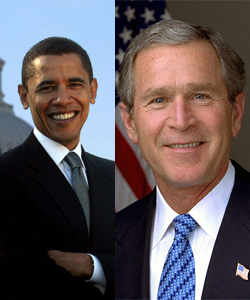
Tara Wall, a reporter for the Washington Times, has written an article for CNN (Wall is also a special correspondent for CNN) arguing that Obama and Bush have agreed on 20 major policy issues. Here's a link to the Wall's analysis. Among the areas of agreement, Wall lists:
* teaching abstinence to children
* capital punishment
* the bailout legislation and tax cuts (for 95% of the
population)
* Bush's energy bill
* faith-based initiatives (something Democrats
criticized)
* FISA (the legislation authorizing wiretapping, something he
previously opposed)
* opposition to same-sex marriage
* Supreme Court's ruling invalidating DC gun ban and finding
individual right to bear arms protected by constitution (many historians had argued that this was a right held by states - not individuals).
The problem with lists like this one is that they do not allow for nuance. The bailout legislation, for example, went through several changes before Congress approved it, and although Obama opposes same-sex marriage, he has not proposed a constitutional amendment banning it (like Bush did). But the list is interesting, and frankly, I'm surprised that it took this long for someone to analyze the ways in which Obama and Bush have agreed in the past. Interesting reading.
Tuesday, September 30, 2008
Yikes! Congress' Approval Ratings Lower Than President Bush's


Bush's historically low approval ratings have received much attention in the media. Real Clear Politics, an excellent, truly nonpartisan political blog, keeps a tally of all major opinion polls related to the presidential election and congressional races. It also collects surveys of job-performance ratings for the president and Congress as a whole.
According to the latest results, Bush's approval ratings range across pollsters from a low of 26% approve and a high of 70% disapprove. As if things could not get worse, approval ratings for Congress range from a low of 15% approve and high of 78% disapprove. Although RCP also provides a rolling average of all the polls, this can distort results because pollsters employ different methodologies. Nevertheless, job-performance numbers for Congress and Bush are extremely close across all pollsters. The range is very tight. So, basically, people do not like Bush's performance, but they dislike Congress' even more. Why do you think the current Congress has even lower numbers than the president with the lowest approval ratings in modern history?
Subscribe to:
Posts (Atom)